Seneca Falls and the Legacy of Women’s Rights
Seneca Falls and the Legacy of Women’s Rights
Why This Place Matters
There are places in America where the ground itself seems to remember. Gettysburg. Selma. Independence Hall. These are locations where the arc of history bent visibly, where words spoken and actions taken rippled outward to reshape the nation. Seneca Falls, New York, is one of these places.
Nestled in the Finger Lakes region of upstate New York, Seneca Falls appears at first glance to be an unassuming small town. The Seneca River flows through its center. Historic brick buildings line Fall Street. In summer, tourists pass through on their way to wineries and lakeside cottages. But this town of fewer than 7,000 residents carries a weight that far exceeds its size. It is, quite simply, the birthplace of the organized women’s rights movement in America.
On July 19 and 20, 1848, approximately 300 people—women and men—gathered in the Wesleyan Chapel on Fall Street for the first Women’s Rights Convention ever held in the United States. Over the course of two sweltering summer days, they debated, discussed, and ultimately signed a document that would become the ideological foundation for seventy-two years of activism. The Declaration of Sentiments, modeled deliberately on the Declaration of Independence, articulated a simple but revolutionary premise: that women were created equal to men and deserved the same rights, opportunities, and protections under the law.
What makes a place historic? Is it the architecture, the physical structures that remain? Or is it something more intangible—the ideas that were born there, the courage that was summoned, the future that was imagined into being? Seneca Falls is historic not because of what it was in 1848, but because of what happened there. A gathering of 300 people in a modest chapel changed the trajectory of American democracy. The reverberations of those two days are still felt today, not just in Seneca Falls, but in every polling place, every boardroom, every classroom where women exercise rights that were once unthinkable.
This is the story of how a small town became sacred ground. It is the story of how a single convention sparked a movement that would span generations. And it is the story of how Seneca Falls has carried the weight of that legacy, preserving and honoring the courage of those who gathered there when demanding equality was an act of radical defiance.
The Summer of 1848: A Gathering Storm
To understand why the Seneca Falls Convention happened when and where it did, we must first understand the woman who made it happen: Elizabeth Cady Stanton.
Born in 1815 in Johnstown, New York, Elizabeth Cady grew up in a household that gave her both privilege and frustration. Her father, Daniel Cady, was a prominent lawyer and judge, and young Elizabeth spent hours in his law office, reading legal texts and listening to women who came seeking help—women who had lost property to their husbands, women who had no legal recourse against abuse, women who discovered that marriage had stripped them of their legal personhood. The law, Elizabeth learned early, did not protect women. In many ways, it actively harmed them.
Her education was exceptional for a girl of her era. She attended Johnstown Academy and later Emma Willard’s Troy Female Seminary, where she received an education comparable to what young men received at the best preparatory schools. But when her male classmates went on to Union College, Elizabeth could not follow. Higher education was closed to women. This pattern—of being intellectually capable but legally and socially constrained—would define her early life and fuel her later activism.
In 1840, Elizabeth married Henry Brewster Stanton, a prominent abolitionist and orator. The wedding ceremony notably omitted the word “obey” from her vows, a small but significant act of defiance. Their honeymoon was a trip to London for the World Anti-Slavery Convention, where Henry was a delegate representing the American Anti-Slavery Society. It was there, in London, that Elizabeth experienced the humiliation that would crystallize her commitment to women’s rights.
The World Anti-Slavery Convention of 1840 was a gathering of progressive thinkers, people committed to the radical notion that all human beings deserved freedom and dignity. Yet when female delegates arrived—including the formidable Lucretia Mott—they were denied seats. After heated debate, the convention voted to exclude women from participating. The female delegates were relegated to a curtained-off gallery, allowed to observe but not to speak, not to vote, not to be counted as full participants in a movement for human rights.
Elizabeth Cady Stanton and Lucretia Mott sat together in that gallery, watching men debate the finer points of human liberty while denying that same liberty to the women in the room. They talked quietly about the bitter irony of it all. They discussed the need for a convention focused specifically on women’s rights. And they planted the seed that would, eight years later, bloom in Seneca Falls.
Lucretia Mott was already a seasoned activist when she met Elizabeth Cady Stanton. Born in 1793 on Nantucket Island, Mott was a Quaker minister, an abolitionist, and a powerful orator. She had been speaking publicly about women’s rights and the abolition of slavery for years, defying social conventions that said women should be silent in public spaces. She was, in many ways, the kind of woman Elizabeth aspired to become—confident, articulate, unafraid to challenge authority.
But in 1840, neither woman was quite ready to organize a women’s rights convention. Elizabeth returned from London to begin her life as a wife and mother. She and Henry settled first in Boston, where she was surrounded by intellectuals and reformers, then moved to Seneca Falls in 1847. The move to Seneca Falls was, by Elizabeth’s own account, a difficult transition. Boston had offered stimulation, conversation, access to the ideas and people shaping reform movements. Seneca Falls offered isolation.
By 1847, Elizabeth Cady Stanton was the mother of three young sons (she would eventually have seven children). She lived in a house on Washington Street that required constant maintenance. Henry traveled frequently for his work, leaving Elizabeth alone to manage the household, care for the children, and cope with the intellectual isolation of small-town life. She was exhausted, frustrated, and increasingly aware of the gap between her capabilities and the narrow role society had assigned her.
It was in this state of mind that Elizabeth reconnected with Lucretia Mott in the summer of 1848. Mott was visiting her sister, Martha Coffin Wright, who lived in nearby Auburn. On July 9, 1848, Elizabeth was invited to tea at the home of Jane Hunt in Waterloo, just a few miles from Seneca Falls. Also present were Lucretia Mott, Martha Wright, and Mary Ann M’Clintock, all Quaker women active in the abolitionist movement.
Over tea, Elizabeth poured out her frustrations—the legal disabilities women faced, the lack of educational and professional opportunities, the way marriage reduced women to legal nonentities. The other women shared their own grievances and stories. The conversation grew animated, urgent. And then someone—accounts differ on who—suggested that they do something about it. Why not hold a convention? Why not call women together to discuss these issues publicly, to name the injustices, to demand change?
The idea took hold immediately. Within hours, they had drafted a notice to be published in the Seneca County Courier: “A Convention to discuss the social, civil, and religious condition and rights of woman, will be held in the Wesleyan Chapel, at Seneca Falls, N.Y., on Wednesday and Thursday, the 19th and 20th of July, current; commencing at 10 o’clock A.M.”
They gave themselves ten days to organize the first women’s rights convention in American history.
The choice of the Wesleyan Chapel was both practical and symbolic. The Wesleyan Methodists were a reform-minded denomination that had split from the main Methodist church over the issue of slavery. They welcomed progressive causes and had no objection to women speaking in their space. The chapel was centrally located on Fall Street, accessible to people traveling from surrounding towns. And it was available.
But the symbolism ran deeper. The Wesleyan Methodists represented a Christianity that took seriously the radical implications of the Gospel—that all people were equal in the eyes of God, that justice and mercy required action, not just prayer. Holding the convention in a chapel signaled that women’s rights were not just a political issue but a moral and spiritual one.
The social and political climate of 1848 made the convention both necessary and possible. The 1840s were a decade of reform movements in America. Abolitionists were organizing, speaking, publishing, and running the Underground Railroad. Temperance advocates were fighting against the social devastation caused by alcohol abuse, which often left women and children destitute and vulnerable to domestic violence. Educational reformers were pushing for public schools and expanded access to learning. Utopian communities were experimenting with new ways of organizing society.
Women were active in all of these movements, but they were rarely allowed to lead. They could organize fundraisers but not speak at rallies. They could write pamphlets but not vote on strategy. They could do the work but not receive the credit or the authority. And in their own lives, they faced legal and social constraints that made them perpetual dependents—first of their fathers, then of their husbands.
Under the legal doctrine of coverture, a married woman had no independent legal existence. Her property became her husband’s property. Any wages she earned belonged to him. She could not sign contracts, sue in court, or make a will without his permission. If she left an abusive marriage, she had no legal right to her children. Divorce was nearly impossible to obtain and carried such social stigma that it often meant complete ostracism.
Single women and widows had slightly more legal autonomy, but they faced severe economic constraints. Most professions were closed to women. Teaching was one of the few respectable options, but female teachers were paid a fraction of what male teachers earned. Women could not attend college or university. They could not vote, serve on juries, or hold political office.
These were not abstract injustices. They shaped every aspect of women’s lives, from the profound to the mundane. A woman could be brilliant, capable, and hardworking, but the law treated her as a perpetual child, incapable of managing her own affairs.
This was the world that Elizabeth Cady Stanton, Lucretia Mott, and the other organizers sought to change. And in the summer of 1848, they believed the time had come to say so publicly.
The Declaration of Sentiments: A Revolutionary Document
On the morning of July 19, 1848, people began arriving at the Wesleyan Chapel in Seneca Falls. They came from the surrounding towns and farms, traveling by horse and carriage over dirt roads. Some came out of curiosity. Others came because they had experienced firsthand the injustices the convention would address. Many were Quakers, members of a religious tradition that affirmed the spiritual equality of women and men. Some were abolitionists who saw the connection between the fight against slavery and the fight for women’s rights.
The organizers had expected a modest turnout, perhaps a few dozen people. Instead, approximately 300 people arrived—including about 40 men. The crowd was so large that the first session, which had been planned as a women-only gathering, had to be opened to men simply because there was no practical way to exclude them.
The convention opened with a speech by Elizabeth Cady Stanton, who was nervous but determined. She had never spoken to a large public audience before. But she had spent the previous days preparing, and she knew what she wanted to say. She spoke about the legal disabilities women faced, the educational barriers, the economic injustices. She spoke about the need for women to claim their rights as citizens and human beings. And then she introduced the document that would become the convention’s lasting legacy: the Declaration of Sentiments.
The Declaration of Sentiments was a stroke of rhetorical genius. Elizabeth Cady Stanton had drafted it with input from the other organizers, and she had made a deliberate choice: she would model it on the Declaration of Independence, the founding document of American democracy. By echoing the structure and language of the Declaration of Independence, Stanton was making a powerful argument. If the principles of 1776 were true—if all men were created equal and endowed with unalienable rights—then those principles must apply to women as well.
The Declaration of Sentiments began with a paraphrase that was both familiar and shocking: “We hold these truths to be self-evident: that all men and women are created equal; that they are endowed by their Creator with certain inalienable rights; that among these are life, liberty, and the pursuit of happiness.”
The addition of three words—”and women”—transformed the meaning of the sentence. It was a simple change, but it exposed the hypocrisy at the heart of American democracy. The Declaration of Independence had proclaimed universal human rights while excluding more than half the population. The Declaration of Sentiments demanded that America live up to its own ideals.
The document then listed grievances, just as the Declaration of Independence had listed grievances against King George III. But instead of a tyrannical monarch, the Declaration of Sentiments named a different oppressor: “The history of mankind is a history of repeated injuries and usurpations on the part of man toward woman, having in direct object the establishment of an absolute tyranny over her.”
What followed was a catalog of injustices, each one a specific way that law and custom had denied women their rights:
He has never permitted her to exercise her inalienable right to the elective franchise—women could not vote.
He has compelled her to submit to laws, in the formation of which she had no voice—women were governed by laws they had no role in creating.
He has made her, if married, in the eye of the law, civilly dead—the doctrine of coverture erased married women’s legal existence.
He has taken from her all right in property, even to the wages she earns—married women had no economic autonomy.
He has denied her the facilities for obtaining a thorough education, all colleges being closed against her—higher education was reserved for men.
He has created a false public sentiment by giving to the world a different code of morals for men and women—the sexual double standard punished women for behavior that was tolerated or even celebrated in men.
He has usurped the prerogative of Jehovah himself, claiming it as his right to assign for her a sphere of action, when that belongs to her conscience and to her God—men had claimed the authority to define women’s proper role, a power that belonged only to God and individual conscience.
The list went on, eighteen grievances in total, each one a specific indictment of the legal and social structures that subordinated women. The language was measured but uncompromising. These were not requests for favors or appeals to male benevolence. They were demands for justice, grounded in the same natural rights philosophy that had justified American independence.
After the grievances came the resolutions—specific demands for change. There were eleven resolutions in total, covering education, employment, legal rights, and moral equality. Most of them passed unanimously or with only minor debate. But one resolution sparked fierce controversy, even among the convention’s supporters: “Resolved, that it is the duty of the women of this country to secure to themselves their sacred right to the elective franchise.”
The demand for voting rights was radical even by the standards of the convention. Many supporters of women’s rights believed that asking for the vote was too extreme, too likely to provoke ridicule and backlash. Even Lucretia Mott, who had been advocating for women’s rights for decades, worried that the suffrage resolution would make the entire convention seem absurd. Henry Stanton was so opposed to the idea that he left town rather than be present when it was debated.
But Elizabeth Cady Stanton insisted. She understood that without political power, women would always be dependent on the goodwill of men. They could petition and plead, but they could not compel. The vote was not just a symbol of equality; it was the mechanism by which all other rights could be secured and protected. If women could vote, they could elect representatives who would change unjust laws. They could hold politicians accountable. They could participate fully in the democratic process.
Frederick Douglass, the great abolitionist and former slave who was living in Rochester at the time, attended the convention and spoke powerfully in favor of the suffrage resolution. Douglass understood better than most the connection between political power and human dignity. He had experienced firsthand what it meant to be denied the rights of citizenship, and he recognized that women’s exclusion from the franchise was a similar injustice. His support was crucial. When the vote was taken, the suffrage resolution passed—but only narrowly.
At the end of the two-day convention, 100 people signed the Declaration of Sentiments—68 women and 32 men. They signed knowing that they would likely face ridicule, social ostracism, and possibly worse. Several signers later asked to have their names removed when the backlash began. But others stood firm, and their signatures remain a testament to their courage.
The Declaration of Sentiments was both an artifact and a manifesto. As an artifact, it captured a specific moment in time—the grievances of women in 1848, the language and ideas available to them, the courage it took to speak publicly about injustice. As a manifesto, it articulated principles that would guide the women’s rights movement for generations. It established the intellectual and moral framework for demanding equality. And it did so in language that was impossible to ignore or dismiss.
The revolutionary nature of the Declaration of Sentiments lay not just in what it demanded, but in how it demanded it. By grounding women’s rights in natural rights philosophy and the principles of the Declaration of Independence, Stanton and the other organizers made it impossible to reject women’s equality without also rejecting the philosophical foundations of American democracy. If the Declaration of Independence was true, then the Declaration of Sentiments must also be true. If America believed in equality and natural rights, then it must extend those principles to women.
This was not a request for special treatment or protection. It was a demand for equal treatment under the law, for the same rights and opportunities that men enjoyed, for recognition as full human beings and citizens. It was, in the truest sense, a revolutionary document.
The Ripples Outward: From 1848 to 1920
The immediate reaction to the Seneca Falls Convention was swift and largely negative. Newspapers across the country mocked the proceedings. The convention was called “the most shocking and unnatural incident ever recorded in the history of womanity.” Editorials ridiculed the idea of women voting, suggesting that next they would want to wear pants and smoke cigars. Even sympathetic observers worried that the convention had gone too far, that demanding the vote would undermine support for more modest reforms.
But the organizers had anticipated resistance. They knew that challenging the fundamental structures of society would provoke backlash. What they could not have fully anticipated was how the ideas articulated in Seneca Falls would spread, take root, and grow into a movement that would span generations.
Two weeks after the Seneca Falls Convention, a second women’s rights convention was held in Rochester, New York. This time, more than 2,000 people attended. The movement was growing. Over the next decade, women’s rights conventions became regular events, held in cities and towns across the North. Each convention drew more attendees, generated more publicity, and recruited more activists to the cause.
The women who had gathered in Seneca Falls became the leaders of this emerging movement. Elizabeth Cady Stanton continued to write, speak, and organize, even as she raised seven children. She formed a partnership with Susan B. Anthony, a younger activist who brought organizational skills and tireless energy to the movement. Together, Stanton and Anthony became the public faces of women’s suffrage, traveling the country to give speeches, lobby legislators, and build support.
Lucretia Mott continued her work as well, speaking at conventions and lending her moral authority to the cause. Lucy Stone, Sojourner Truth, Frances Ellen Watkins Harper, and countless other women joined the movement, each bringing their own perspectives and experiences. The movement was never monolithic—there were disagreements about strategy, priorities, and tactics—but it was united by the principles articulated in Seneca Falls.
The Civil War interrupted the women’s rights movement, as activists turned their attention to abolition and the war effort. Many women’s rights advocates were also abolitionists, and they believed that ending slavery was the most urgent moral imperative. They hoped that after the war, when the nation was reconstructing itself, women would be included in the expansion of rights and citizenship.
But the Fourteenth and Fifteenth Amendments, which granted citizenship and voting rights to formerly enslaved people, specifically excluded women. The Fourteenth Amendment introduced the word “male” into the Constitution for the first time, defining voters as male citizens. The Fifteenth Amendment prohibited denying the vote based on “race, color, or previous condition of servitude,” but it said nothing about sex.
The exclusion of women from these amendments was a bitter disappointment and led to a split in the women’s rights movement. Some activists, including Lucy Stone, supported the amendments despite their limitations, arguing that it was “the Negro’s hour” and that women’s suffrage would come later. Others, including Elizabeth Cady Stanton and Susan B. Anthony, opposed the amendments because they excluded women and feared that accepting this exclusion would set back the cause of women’s suffrage for generations.
The split led to the formation of two rival organizations: the American Woman Suffrage Association, led by Lucy Stone, which focused on winning suffrage state by state and maintained ties with Republican politicians; and the National Woman Suffrage Association, led by Stanton and Anthony, which demanded a federal constitutional amendment and took more radical positions on issues like divorce and labor rights. The two organizations would not reunite until 1890, when they merged to form the National American Woman Suffrage Association.
Despite the setbacks and divisions, the movement continued to grow. Women organized petition drives, gathering thousands of signatures demanding the vote. They testified before legislative committees, making the case for suffrage with logic, passion, and persistence. They published newspapers and pamphlets, wrote books and articles, and used every available platform to spread their message.
Some states began to grant women the vote, starting with Wyoming Territory in 1869. Colorado, Utah, and Idaho followed in the 1890s. These victories were important both practically and symbolically—they proved that women could vote responsibly and that the dire predictions of social chaos were unfounded.
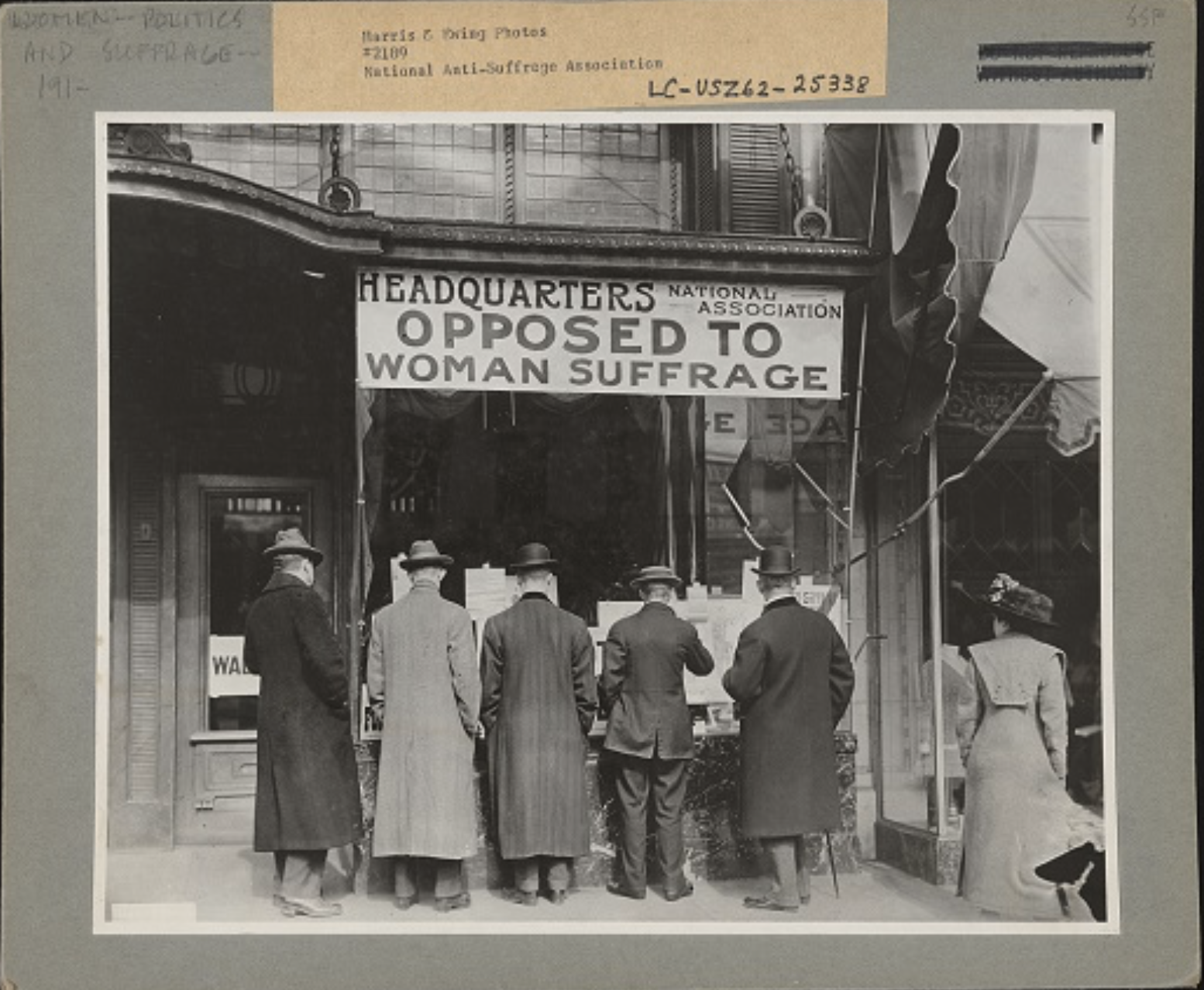
But progress was slow and uneven. For every state that granted women the vote, there were many more that rejected it. Southern states were particularly resistant, as white politicians feared that women’s suffrage would lead to Black women voting. Anti-suffrage organizations formed, arguing that voting would corrupt women’s moral purity, destroy the family, and undermine social order. The liquor industry opposed suffrage because women were seen as supporters of temperance. Political machines opposed it because they couldn’t control how women would vote.
The movement adapted its strategies over time. In the early twentieth century, a new generation of activists brought fresh energy and new tactics. Alice Paul and Lucy Burns, inspired by the militant tactics of British suffragettes, organized parades, pickets, and protests. In 1913, they organized a massive suffrage parade in Washington, D.C., timed to coincide with Woodrow Wilson’s inauguration. More than 5,000 women marched, and the parade drew national attention—as did the violence when crowds of men attacked the marchers while police stood by.
During World War I, suffragists faced a strategic choice: should they suspend their campaign to support the war effort, or should they continue to press for the vote? Different factions made different choices. Carrie Chapman Catt, president of the National American Woman Suffrage Association, supported the war effort while continuing to lobby for suffrage. Alice Paul and the National Woman’s Party picketed the White House, holding signs that accused President Wilson of hypocrisy for fighting for democracy abroad while denying it to women at home. Paul and other picketers were arrested, jailed, and force-fed when they went on hunger strikes.
The combination of tactics—patient lobbying and militant protest, state campaigns and federal pressure, appeals to justice and demonstrations of women’s patriotism—finally began to shift public opinion and political calculations. By 1918, President Wilson, who had long opposed women’s suffrage, announced his support for a constitutional amendment. The House of Representatives passed the amendment in 1918, but it stalled in the Senate. It passed the Senate in 1919 and was sent to the states for ratification.
The ratification campaign was intense. Suffragists and anti-suffragists battled in state legislatures across the country. By the summer of 1920, 35 states had ratified the amendment—one short of the 36 needed. The final battle came down to Tennessee. On August 18, 1920, the Tennessee legislature voted on ratification. The vote was tied until Harry Burn, a young legislator who had been expected to vote no, changed his vote to yes after receiving a letter from his mother urging him to support suffrage. The Nineteenth Amendment was ratified.
On August 26, 1920—seventy-two years after the Seneca Falls Convention—the Nineteenth Amendment became part of the Constitution: “The right of citizens of the United States to vote shall not be denied or abridged by the United States or by any State on account of sex.”
The connection between Seneca Falls and the ratification of the Nineteenth Amendment was direct and profound. The Declaration of Sentiments had articulated the principle that women deserved the vote. The convention had launched a movement that persisted through decades of setbacks, ridicule, and opposition. Many of the women who signed the Declaration of Sentiments did not live to see women’s suffrage—Elizabeth Cady Stanton died in 1902, Susan B. Anthony in 1906—but they had laid the foundation. They had planted seeds that took generations to bear fruit.
Seneca Falls became a touchstone for the movement, a place activists returned to in memory and sometimes in person. When suffragists needed to remind themselves why they were fighting, they looked back to that summer day in 1848 when 300 people gathered in a chapel and dared to imagine a different future. When they needed to explain their cause to skeptics, they pointed to the Declaration of Sentiments and its clear, logical argument for equality. When they needed courage, they remembered the women who had signed that document knowing they would face ridicule and worse.
The ripples from Seneca Falls extended far beyond suffrage. The convention had demanded not just the vote but a comprehensive transformation of women’s legal, economic, and social status. Over the course of the twentieth century, many of those demands were realized. Women gained access to higher education, entering colleges and universities in increasing numbers. Married women gained the right to own property, sign contracts, and keep their own wages. Divorce laws were reformed. Employment discrimination was challenged. The specific grievances listed in the Declaration of Sentiments were, one by one, addressed and remedied.
But the work was never finished. Each generation of women discovered new barriers, new forms of discrimination, new ways that law and custom limited their opportunities and autonomy. And each generation looked back to Seneca Falls as the beginning, the moment when women first gathered publicly to demand their rights, the place where the movement was born.
Sacred Ground: Seneca Falls in the Modern Era
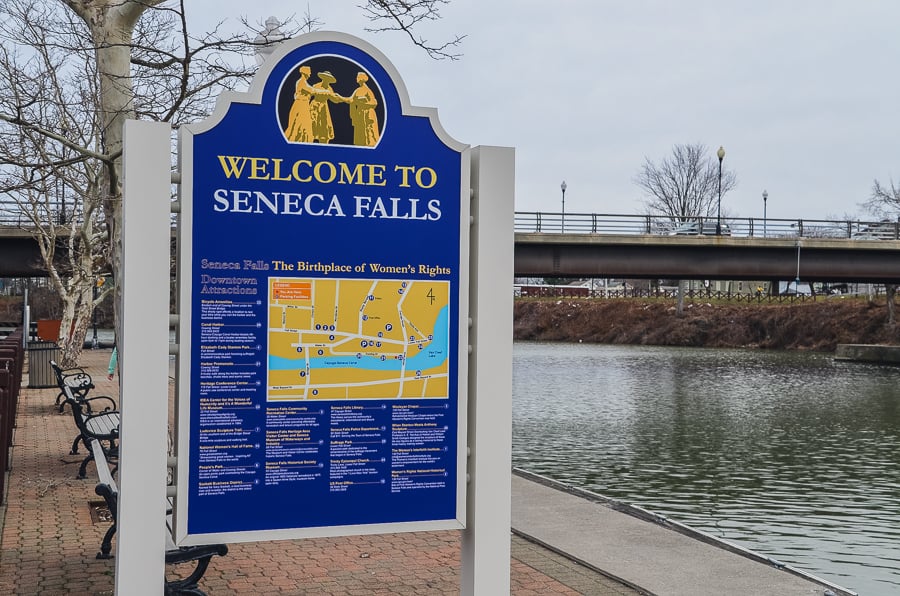
Today, Seneca Falls is a town that has embraced its role as the birthplace of women’s rights. The legacy of 1848 is everywhere—in the street names, the historic markers, the museums and monuments that dot the landscape. But more than that, it is in the town’s identity, in how residents understand their place in history and their responsibility to that history.
The Women’s Rights National Historical Park, established in 1980, is the physical and symbolic center of this legacy. Located at 136 Fall Street, the park encompasses several sites related to the 1848 convention and the early women’s rights movement. The visitor center occupies a renovated building near the site of the original Wesleyan Chapel, which was destroyed by fire in the 1870s and later demolished. The chapel site itself is now marked by a bluestone waterfall and a wall inscribed with the Declaration of Sentiments, a contemplative space where visitors can reflect on the courage of those who gathered there.
The park also includes the Elizabeth Cady Stanton House on Washington Street, where Stanton lived when she organized the convention. The house has been restored to its 1848 appearance, and visitors can walk through the rooms where Stanton wrote speeches, raised her children, and imagined a different future for women. Standing in those rooms, it’s possible to feel the weight of history, to imagine the frustration and determination that led Stanton to organize the convention.

The National Women’s Hall of Fame, located in downtown Seneca Falls, honors women who have made significant contributions to American society. Inductees include scientists, artists, activists, politicians, and athletes—women who have excelled in every field of human endeavor. The Hall of Fame is a reminder that the work begun in 1848 opened doors for generations of women, creating opportunities that would have been unimaginable to the convention’s organizers.
But Seneca Falls is more than a museum town, more than a collection of historic sites. It is a living community that continues to grapple with the legacy of 1848 and what it means to be the birthplace of women’s rights. The town hosts events and programs throughout the year that explore women’s history and contemporary issues of gender equality. Scholars, activists, and ordinary citizens come to Seneca Falls to learn, to reflect, and to be inspired.
For many visitors, coming to Seneca Falls is a kind of pilgrimage. They come to stand where the convention was held, to see the places where Stanton and the other organizers lived and worked, to connect with the history in a tangible way. There is something powerful about being in the actual place where history happened, about walking the same streets, breathing the same air, seeing the same river that the convention organizers saw.
This sense of place matters. History can feel abstract when it’s confined to books and classrooms. But when you stand on the site of the Wesleyan Chapel, when you read the words of the Declaration of Sentiments inscribed on the wall, when you imagine 300 people crowding into a small chapel on a hot July day, history becomes real. You understand that these were not mythical figures but real people who made a choice to speak up, to challenge injustice, to risk ridicule and ostracism for the sake of a principle.
The park rangers who lead tours at the Women’s Rights National Historical Park are skilled at bringing this history to life. They tell stories about the convention organizers—their backgrounds, their motivations, their fears and hopes. They explain the legal and social context that made the convention necessary. They trace the connections between the 1848 convention and the long struggle for women’s suffrage. And they invite visitors to think about how the issues raised in Seneca Falls remain relevant today.
Because the work is not finished. The Nineteenth Amendment granted women the vote, but it did not end gender discrimination. Women still face barriers in employment, education, politics, and countless other areas of life. The wage gap persists. Women remain underrepresented in positions of power and leadership. Violence against women continues to be a pervasive problem. The specific grievances may have changed since 1848, but the fundamental challenge remains: how do we create a society that truly treats women as equal to men?
Seneca Falls reminds us that progress is possible but not inevitable. The women who gathered in 1848 did not know if they would succeed. They could not have predicted that it would take seventy-two years to win the vote, or that even after winning the vote, the struggle for equality would continue. But they acted anyway. They spoke up anyway. They organized and petitioned and persisted anyway.
This is perhaps the most important lesson that Seneca Falls teaches: that change begins with people who are willing to name injustice and demand something better. The convention organizers were not superhuman. They were ordinary people—mothers, wives, daughters, sisters—who decided that the status quo was unacceptable. They were people who believed that they deserved better and were willing to work for it.
The town of Seneca Falls has taken seriously its responsibility to preserve and share this history. The Women’s Rights National Historical Park is meticulously maintained. The exhibits are thoughtful and educational. The programs and events are designed to engage visitors of all ages and backgrounds. But beyond the official sites and programs, there is a sense throughout the town that this history matters, that it is something to be proud of and to learn from.
Local schools teach students about the 1848 convention and the women’s rights movement. Community organizations host discussions and lectures on women’s history and contemporary gender issues. The town celebrates its heritage while also acknowledging that the work of achieving equality is ongoing.
This balance—between honoring the past and engaging with the present—is what makes Seneca Falls more than just a historic site. It is a place where history is alive, where the questions raised in 1848 are still being asked and answered. What does equality mean? How do we achieve it? What are we willing to sacrifice for it? These are not abstract philosophical questions; they are practical, urgent questions that each generation must answer for itself.
Visitors to Seneca Falls often describe feeling moved, inspired, even transformed by their experience. There is something about standing on ground where history was made that changes how you think about your own life and your own responsibilities. If 300 people in a small town in upstate New York could launch a movement that changed the nation, what might be possible today? If women who had no legal rights, no political power, no institutional support could organize and persist for seventy-two years until they won the vote, what excuse do we have for not working toward justice in our own time?
These are the questions that Seneca Falls poses to every visitor. And they are questions without easy answers. But they are the right questions, the necessary questions, the questions that must be asked if we are to continue the work begun in 1848.
The physical landscape of Seneca Falls has changed since 1848. The Wesleyan Chapel is gone, replaced by a parking lot and a memorial. The town has grown and modernized. The Seneca River still flows through the center of town, but it is now channeled and controlled, no longer the wild waterway it once was. Yet despite these changes, there is a continuity, a sense that the past is still present.
This is what makes a place sacred: not that it is unchanged, but that it is remembered. Not that it is frozen in time, but that it continues to speak to each new generation. Seneca Falls is sacred ground because of what happened there in 1848, but also because of how that history has been preserved, honored, and passed down. It is sacred because people continue to come there seeking inspiration, seeking connection to something larger than themselves, seeking to understand how ordinary people can change the world.
The legacy of Seneca Falls extends far beyond the town itself. The principles articulated in the Declaration of Sentiments have influenced women’s rights movements around the world. The example of the 1848 convention has inspired countless other gatherings, other declarations, other movements for justice. The courage of the women who signed the Declaration of Sentiments has given courage to generations of activists who have faced their own battles for equality.
But the heart of that legacy remains in Seneca Falls, in the place where it all began. The town carries the weight of that history with grace and purpose, understanding that being the birthplace of women’s rights is both an honor and a responsibility. It is an honor to be associated with such a pivotal moment in American history. It is a responsibility to preserve that history accurately, to share it generously, and to continue the work of building a more just and equal society.
When you visit Seneca Falls today, you are not just visiting a historic site. You are entering into a conversation that began in 1848 and continues to this day. You are joining a long line of people who have stood on that ground and asked themselves what they are willing to do for justice, for equality, for a better future. You are connecting with a history that is not dead and buried but alive and urgent.
This is the power of place. This is why Seneca Falls matters. Not because of what it was, but because of what it represents: the possibility of change, the power of ordinary people to challenge injustice, the long, difficult, necessary work of building a more equal society. The ground itself remembers. And so must we.
Conclusion
On a summer day in 1848, 300 people gathered in a small chapel in Seneca Falls, New York, and changed the course of American history. They did not know if they would succeed. They could not have imagined how long the struggle would take or how many obstacles they would face. But they believed that women deserved equality, and they were willing to say so publicly, to put their names on a document that demanded justice, to begin a movement that would outlast their own lives.
Seventy-two years later, women won the right to vote. But the work did not end there. Each generation has had to continue the struggle, to address new forms of discrimination, to push for fuller and more complete equality. And each generation has looked back to Seneca Falls as the beginning, the place where it all started, the ground where the seeds of change were planted.
Today, Seneca Falls stands as a testament to the power of courage, persistence, and vision. It reminds us that change is possible, that ordinary people can accomplish extraordinary things, that speaking truth to power is never easy but always necessary. It challenges us to ask what we are willing to do for justice in our own time, what risks we are willing to take, what sacrifices we are willing to make.
The legacy of Seneca Falls is not just about the past. It is about the present and the future. It is about the ongoing work of building a society that truly treats all people as equal, that gives everyone the opportunity to develop their talents and pursue their dreams, that judges people by their character and capabilities rather than their gender.
This is the work that began in Seneca Falls in 1848. This is the work that continues today. And this is why Seneca Falls will always be sacred ground—not because it is perfect, not because the work is finished, but because it is where people first dared to imagine that women deserved equality and were willing to fight for it. The ground remembers. And so must we.