What Belongs Here
Every year, at some point in early winter, I catch myself standing in my house feeling like a stranger in a strange land. After months of breezing in and out, corn deliveries, stand restocks, market weekends, home becomes the place where I eat, sleep, and try to keep up with the laundry.
If summer is frantic,
winter is the reckoning.
And honestly? I wouldn’t have it any other way. Winter is for reflection. For quiet. For coming back to myself.
When the world outside goes quiet and the fields sleep, the inside of my home finally begins to speak. Winter has a way of holding up a mirror, showing me what I’ve overlooked, what I’ve rushed past, what hasn’t been tended in months. And in that stillness, I start paying attention again, to the rooms, to the small details, to the objects that invite me back into my own life.
And I don’t think this feeling is unique to me. Humans have always prepared themselves for winter, adjusting their homes and habits with the seasons. The Danes call it hygge; some call it nesting or simply creating a cozy space, but really it’s just an echo of something ancient. When the days get shorter, we draw inward. We make our surroundings warmer, and gentler.
It’s instinct as much as intention.
This particular year, as I stood in the center of my dining room and kitchen, the usual offenders were obvious. It had been a few years since I painted, and it was time again. The baseboards needed scrubbing. The dining room light fixture had officially reached “replace me” status. I dropped the glass globe while changing lightbulbs over summer, and we had been living with a bare bulb light fixture above the table…Definitely not cozy.
But there was something else, something deeper than housekeeping. I realized I was finally ready to shed all the modern farmhouse touches I’d been layering into my home for years.
Like so many others around 2018 and 2019, I was completely smitten with the trend. I never installed shiplap (though trust me, I came dangerously close), but I chased that aesthetic hard enough to realize it didn’t feel like me, and it didn’t suit my house, which was built in the 1800s.
It surprised me how quickly everything shifted once I finally admitted that the modern-farmhouse version of me had quietly packed her bags and moved on. Almost without trying, I started reaching for pieces that felt like home, the farms, the barns, the kitchens that always smelled faintly of woodsmoke. Not in a Pinterest-board way, but in a deep, familiar way.

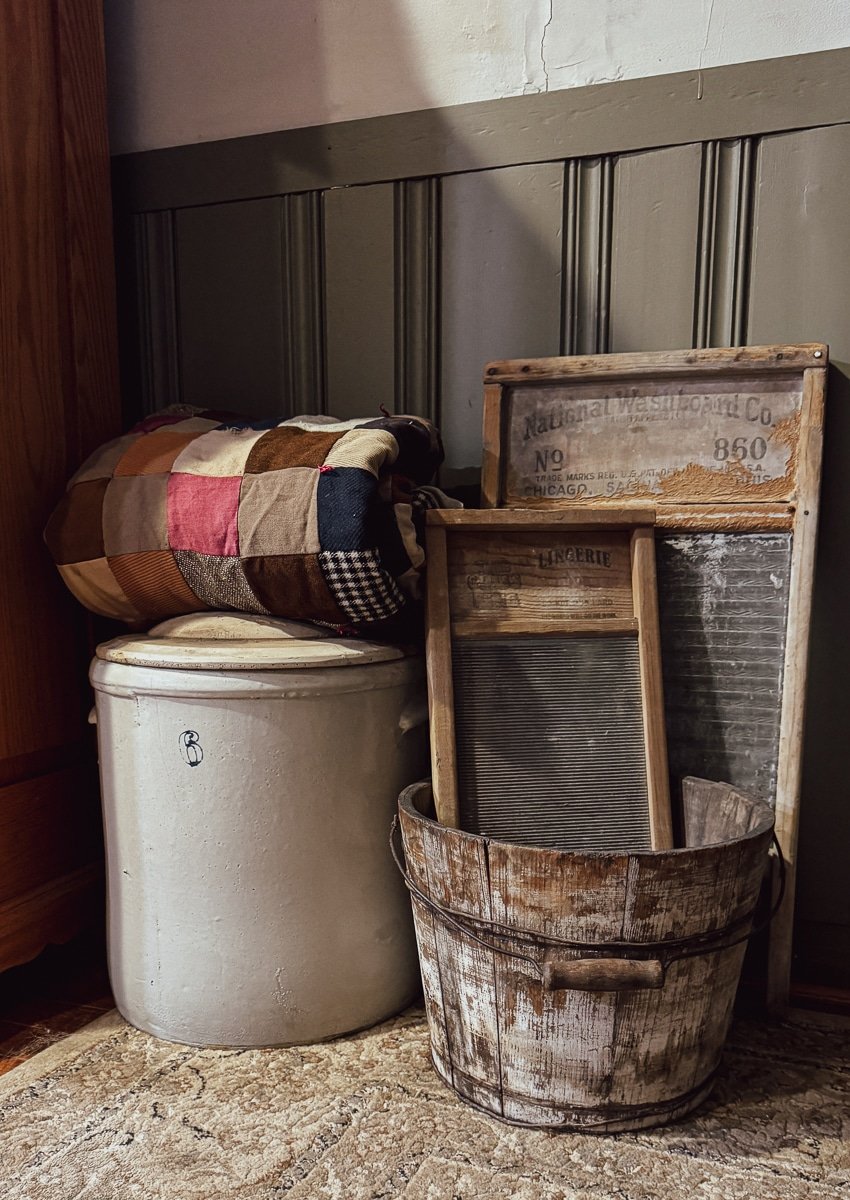
Worn wood. Honest lines. Handmade things that carried the fingerprints of their makers, and whispers of whoever used them last. These were the objects that began calling to me, not the mass-produced décor pieces I’d picked up at big box stores during my modern farmhouse phase, but things with weight. With texture. With history. Things that, if you listen carefully, might just echo their past.
It felt less like redecorating and more like remembering.
I found myself reaching back for the pieces that felt closest to my roots, the simple, sturdy, timeworn things that echoed the orchards, barns, and old farm kitchens. Not the curated versions that end up on trend boards, but the authentic, imperfect objects that feel lived-in and familiar.
A patina earned through years of use. These pieces didn’t just decorate a room; they grounded it. They grounded me.
And strangely, it felt like my house recognized them, like these worn, time-touched objects belonged here in a way nothing else could
The more I leaned into it, the more I understood why winter had nudged me there. Winter asks for honesty. It strips everything down to the essentials, and somehow our homes follow suit. I didn’t want clever décor anymore; I wanted objects with stories woven into them. Things that carry their own quiet wisdom. Things that make a home feel warm, and deeply human.
Honest pieces for an honest season.
Once I admitted what I wanted my home to feel like, the right things started showing up, almost as if they’d been waiting for me to catch up. And nothing proved that more than the chandelier.
I’d been side-eyeing my dining room light fixture with its bare bulbs for months. It had officially crossed over into “I served my time” territory. So when I spotted a primitive-style chandelier on Marketplace, all candles, curves, and quiet early American charm. I felt that little internal click. The one that says: this belongs here.
The seller had bought the chandelier years ago for her lake cottage, from a little local shop. She adored it, truly loved it, but the ceilings in the cottage were low, and her six-foot-something son kept smacking his head on it. She tried to make it work: adjusting, shifting, raising.
Eventually, she realized it needed a new home, one where it could shine without concussing anybody. There’s something about an object that’s been loved before, it carries a kind of warmth you can’t fake. I didn’t even try to haggle, despite having my own reservations if it would work in my space, or if we would also be whacking our heads on it.
But when we hung it in my dining room?
It was instant.
Like the house exhaled and said, finally.
The candles, the shape, the soft glow, it grounded the whole space in a way my modern farmhouse fixture never could, not even on its best day with a globe. This one felt meant. It felt true. It felt like the kind of light that belonged in a house built in the 1800s, offering a cozy glow through winter evenings.
It wasn’t just décor.
It was a homecoming.
Once the chandelier was in place, I couldn’t unsee the difference.
The modern farmhouse touches that once felt perfectly fine now looked… well, not wrong, but not right. Not for this house, not for this season of my life. The chandelier made everything else come into focus. Suddenly I could see what belonged and what didn’t. Pieces I had walked past a hundred times without really noticing now felt out of step, while others scattered around the house seemed to raise their hands and say, I belong.
I started visiting the antique mall and thrift shops weekly, following that pull toward things with history and heart. I wasn’t hunting for anything specific, no checklist, no inspiration board, just seeing what spoke to me. And surprisingly, things did. Objects I would’ve skimmed past a year ago now stopped me in my tracks with that same familiar feeling: you already know me.

One of the first was a grape harvest basket, its handles worn smooth from hands I’ll never know, though somehow I know their rhythm. The seasonal story of harvesting grapes by hand, a crop so deeply tied to this region, lived in every scuff and softened edge. It felt like picking up a small piece of Finger Lakes history, something humble and sturdy that had actually worked for a living.
Now it’s been reincarnated as a centerpiece on my table, settling in under the glow of the chandelier, holding an ironstone pitcher full of fresh evergreen clippings and a few wooden bowls, as if it had always belonged there. A quiet bridge between the past and the home I’m creating now
Standing there, looking at that old grape basket under the chandelier’s warm glow, I realized how clearly my home was telling me what it wanted to be. The pieces that felt right, the worn wood, the ironstone, the practical beauty of objects that had lived real working lives, all pointed in the same direction: a humble, early American aesthetic. Not a theme, not a Pinterest board, but a way of honoring the kind of house this is, and the kind of life it was built for.
It made me see the walls differently too. The cool grays and bright whites I’d painted years ago suddenly felt out of place, like they belonged to a version of me, and a version of this house that I’d outgrown. This home wasn’t asking for crisp modern tones. It wanted colors with weight, warmth, and history behind them. Colors that looked like they’d been here a long time.
So I started repainting, one wall at a time, trading stark white for the soft, lived-in calm of Natural Linen, and covering the cool gray with Benjamin Moore’s Tate Olive, a deep, earthy green that feels right at home in the 1800s. The kind of color you could picture behind a candle flame or next to a hand-hewn table. A color that seems to just settle into the space, steady and sure.
As those colors dried, the house felt quieter, more grounded, more itself. And honestly? So did I.
My house is still transitioning. Alongside the realization that I wanted to be surrounded by authentic pieces with history and story, was also the fact that finding the right things takes time. Maybe that’s a patience that comes with time, or maybe it’s simply what happens when you stop decorating a house and start listening to it.
I used to want everything finished at once, every room pulled together, every corner styled. But this? This feels different. Early American homes weren’t assembled in a season; they were layered slowly, shaped by need, by use, by whatever a family could make or trade for. There’s something comforting about allowing my own home to evolve the same way, not rushed, not curated, but gathered.
So I’m letting the process be slow. Letting the right pieces find me when they’re meant to. Letting my house and I meet each other halfway, both of us settling into something a little truer, a little steadier, a little more ourselves.
And maybe that’s the quiet gift of winter: it reminds us to listen, to notice, and to choose what truly belongs here… in our homes, and in ourselves.